
For island utilities
Lower, predictable power costs, without compromising reliability
We design, finance and deliver a baseload solar-and-storage system around your grid, your demand and your existing diesel fleet
ENERGY independence
Power made on the island, not shipped to it.
On a diesel island almost every kilowatt-hour starts as fuel shipped in. A BRES system makes the island’s power from its own sun, stores it for the night, and keeps the existing diesel as cover for the few low-solar stretches in a year.
The result is power that no longer depends on a tanker schedule, or on oil-price swings thousands of kilometres away.
Reliability and baseload
Sized hour by hour, for the cloudiest week of the year
We model every hour of a full weather year. Below is an example from CI-BRO, our in-house model, for one island grid: a normal day and the cloudiest week of the year. Every island gets its own model, with its own demand and weather. no longer depends on a tanker schedule or an oil market thousands of kilometres away.
- Solar to the island
- Battery to the island
- Diesel
- Solar charging the battery
- Spare solar (curtailed)
- Demand
- Night
- Solar to the island
- Battery to the island
- Diesel
- Solar charging the battery
- Spare solar (curtailed)
- Demand
- Night
Example: CI-BRO hourly dispatch for one island grid, based on 2023 hourly solar resource. Grey bands mark the night hours. Hover over or tap the chart to see each hour.
Scenarios we test for every island
Demand Growth
Population, tourism and electrification of transport and cooling.
Weather Years
Several years of irradiance, so sizing holds in a dull year, not only an average one.
Fuel and technology costs
Oil price paths and solar, battery and long-duration storage cost curves.
Diesel integration
Your diesel fleet stays. Its job changes.
Existing generators move from main supply to reserve. Solar runs the island by day and charges the battery; the battery carries it through the night. The generators stay connected and maintained, and start automatically only when the battery reaches its reserve in a long cloudy spell.
They supply just 1–5% of a year’s power, at the lowest overall cost, from assets you have already paid for.
Grid stability
Stable frequency and voltage on a grid with no spinning engines.
On a small island grid the diesel engines have always provided the inertia that keeps frequency steady and the lights on through a fault. A BRES system takes over that job.
Frequancy
Population, tourism and electrification of transport and cooling.
Voltage
Inverters supply reactive power where it is needed, holding voltage within limits across the network.
Intertia
Synthetic inertia from the battery replaces the rotating mass of the engines, so the grid rides through faults and switching events instead of blacking out.
Price and risk certainty
Plan your tariffs years ahead.
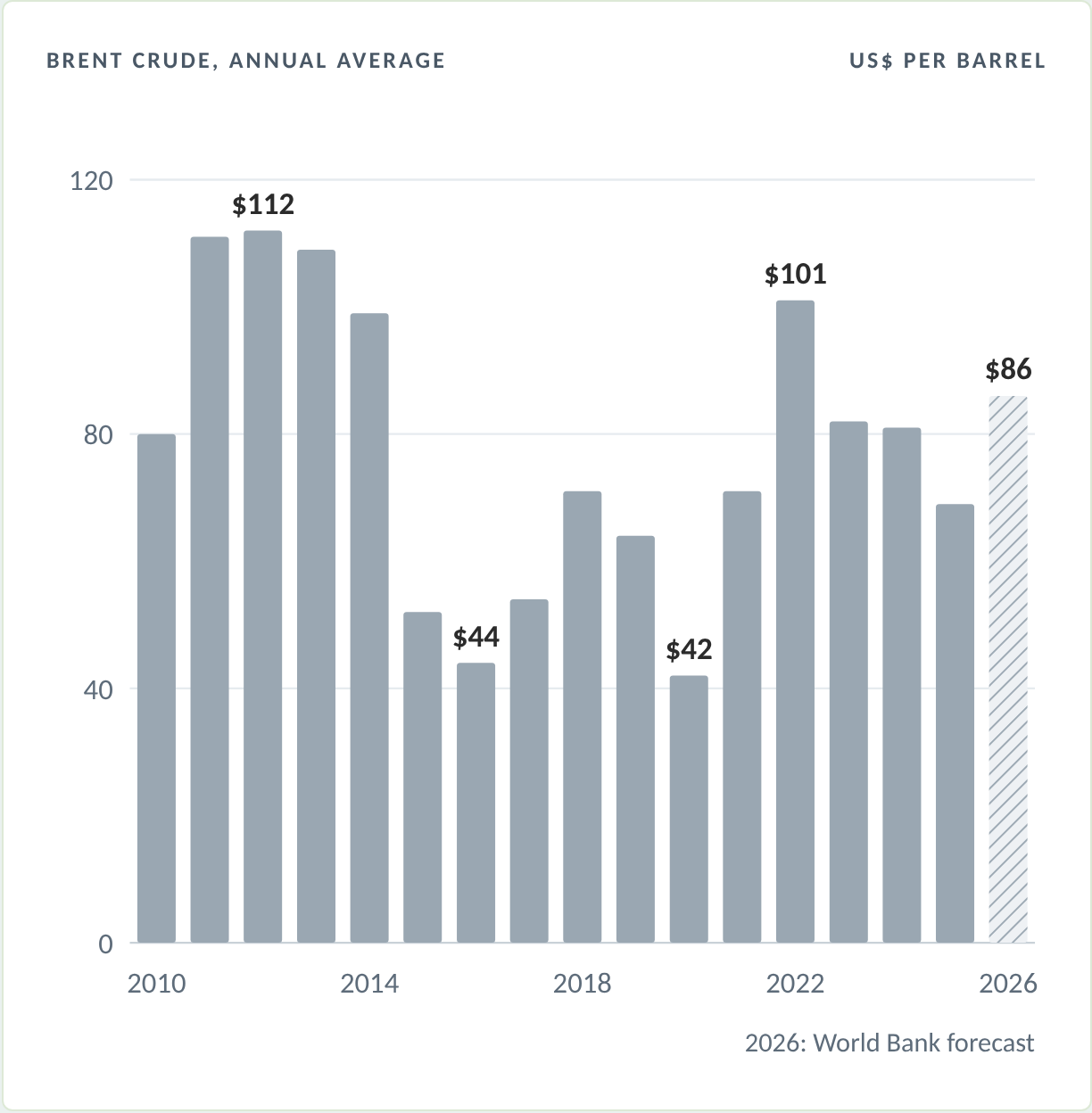
Once a BRES system is built its cost is largely set: about $175 per MWh on our reference island, where about 95% of the power needs no fuel and no shipment. Oil has swung between about $42 and $112 a barrel in the last fifteen years, and even the forecasts miss.
| Oct 2025 | The World Bank expected commodity prices to fall to a six-year low in 2026 as the oil glut grew. |
| Mar 2026 | On Curaçao, diesel rose about 36% in a single price adjustment, and household electricity about 7% a day later. |
| Apr 2026 | The World Bank revised its 2026 Brent forecast to $86, after the largest oil supply shock on record. |
Try it with your numbers
What does diesel power cost your island?
Indicative: reference island at 2026 costs, 10-year lifetime, 10% WACC. Diesel = 0.27 l/kWh × your price + $0.06/kWh generators and O&M. Your island needs its own model; we are happy to run it.
Enter what your utility pays for a litre of delivered diesel and compare it with BRES at 2026 costs, using the same formula as our model.
How we work together
From first data to first power
Pre-feasibility
Your demand data, grid and site options give a first sizing and cost range.
Modelling and design
Hourly dispatch over a full weather year, grid studies and the system design.
Development
Land, permits, grid connection and the commercial agreement.
Financing
Project structure, lenders, development finance institutions and investors.
Construction
Procurement and EPC management through to commissioning.
Operation
Monitoring and dispatch, with diesel on standby.